The First Commandment
How the Ten Commandments Point Through Jesus to the New Heaven and New EarthThe First Commandment: You Shall Have No Other Gods
No other gods: no created thing, power, institution or desire may replace the centre of worship.AI and sharing toolsAsk
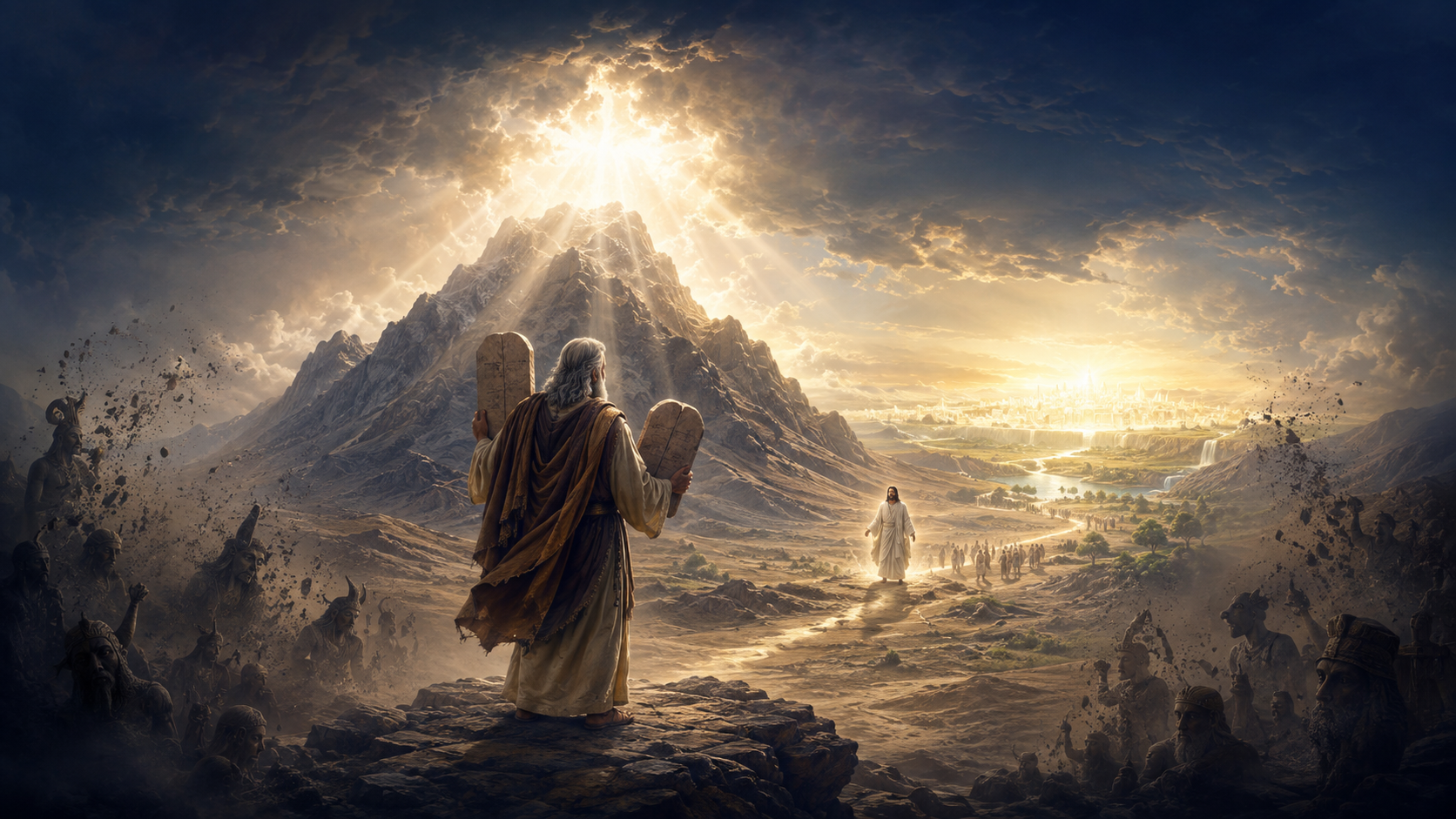
I am the LORD your God … You shall have no other gods before me.
The commandment does more than reject polytheism: the one God reveals himself, rescues and makes covenant, and the redeemed worship him alone.
Five problems exposed by the First Commandment
Does truth have one foundation?
If God is merely one option, love, justice, good and worship lose their final measure.
Is the heart’s worship divided?
Power, wealth, institutions, leaders and desire can quietly occupy God’s place.
Who defines God?
God is not shaped around human needs; he reveals himself and calls for a response.
Worship rests on rescue
Before the command comes: “I brought you out.” Obedience answers redemption.
Worship reorders all of life
The centre of worship shapes choices, relationships, responsibility, hope and final direction.
The First Commandment across Scripture
- 01
Sinai revelation
The one God declares himself
- 02
Covenant worship
The rescued must not turn to other gods
- 03
Jesus reveals the Father
Christ shows God’s character and redemption
- 04
The nations are called
Turn from idols to the living God
- 05
Final worship
God and the Lamb are the City’s eternal centre
Four layers of the First Commandment
Reject other gods; worship the one God
The command establishes monotheism and exclusive worship.
Begin with “I am the LORD your God”
The command rests on prior revelation, rescue and covenant, and moves through Christ toward the nations.
No statue means no rival god
Money, success, community, authority or the self can still become the practical highest centre.
Not only removing idols, but restoring the centre
The whole life returns to God; Jesus restores true worship and obedience to the Father.
Old and New Testament echoes
The LORD is one. He rescues first, then calls for undivided love and worship.
Jesus refuses worship of created power and reveals his unity with the Father.
Believers turn from idols to the one God and confess one Lord, Jesus Christ.
God and the Lamb are the City’s centre; his servants worship him and see his face.
Through Jesus, the First Commandment points to the New Creation: the one God rescues, Christ restores true worship, and God and the Lamb become the centre of all life, light and order forever.
A traditional reading of this commandment +
Historic Christian teaching usually treats this commandment as part of God’s moral will and sees Jesus carrying it into the human heart. Traditions differ on how the Law applies within Church life.
This site’s synthesis
The First Commandment begins not merely with “you shall not,” but with God’s declaration that he brought his people out. It exposes the elevation of religion, power, desire or any created thing into God’s place, and declares that true faith begins with the one God revealing himself, rescuing and making covenant—not humanity selecting among gods.